
FourFeetz Quality Review · Production Notes
What We Check Before Publishing an Animal Character Short
The practical face, limb, accessory, background, camera and edit-continuity checks FourFeetz uses before an animal character short is published.
Production Record
Based on original FourFeetz project frames, test clips, and published work.
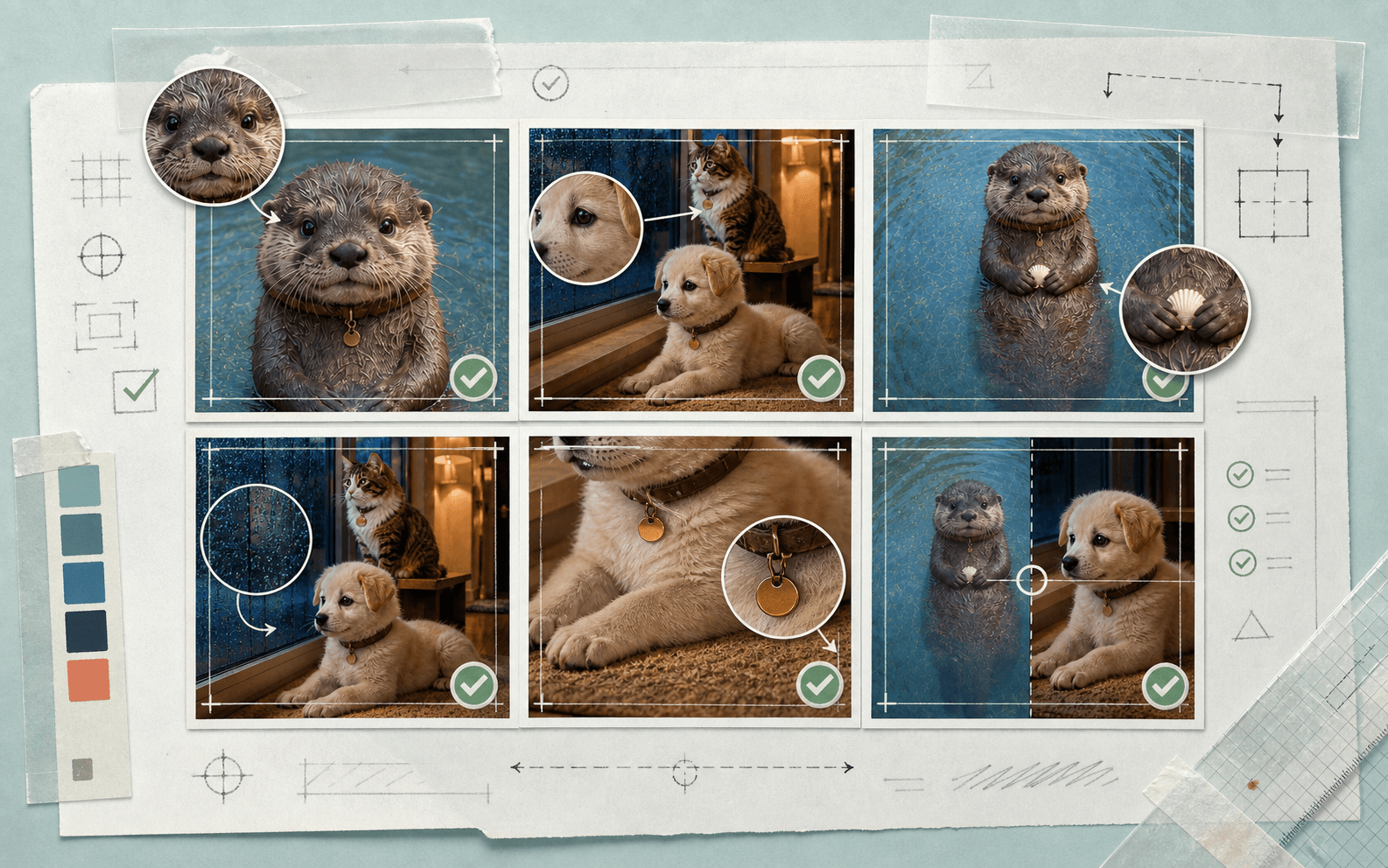
Quick verdict
A clip is publishable only when character identity, animal anatomy, environment and edit continuity survive normal playback and frame review. A polished effect never overrides a broken face, limb or scene connection.
FourFeetz production notes
What We Tested: Review at Three Speeds
FourFeetz reviews a candidate at normal speed for story and rhythm, without sound for visual continuity, and frame by frame around difficult movement or joins. The OLI swimming short made this especially useful because water can hide a leg for a moment while also creating believable reflections and contact. Watching only at normal speed can miss a changing paw; studying only still frames can reject motion that reads naturally in playback.
We compare the clip with the approved character page or First Shot. The checklist covers face and apparent age, ears, visible legs and paws, tail, collar or name tag, body-to-ground or body-to-water contact, background geometry, light direction, camera speed and the physical connection to adjacent scenes.

FourFeetz production notes
What Went Wrong: Accepting a Strong Moment With a Hidden Failure
An expressive face or attractive camera move can pull attention away from a missing paw, duplicated leg or accessory that changes position. The error often becomes more visible after a loop, a crop or a neighboring shot is added. FourFeetz therefore does not approve a clip from its best frame; the complete usable range has to pass.
Backgrounds are checked as physical spaces. Window frames, creek banks, furniture edges and horizon lines should not bend or jump without a story reason. A moving camera also has to remain motivated. Fast motion that merely hides identity drift is a rejection reason, not a finishing technique.
- Face, muzzle, eye spacing and apparent age
- All visible legs, paws, ears and tail
- Collar, scarf or name-tag position
- Ground or water contact
- Background lines, light and camera direction
- Start and end frames at every edit join
FourFeetz production notes
What Worked: Fix the Smallest Failing Layer
When the problem is in a short removable range, the usable portion can be trimmed. When two valid scenes need a gentle passage, a short dissolve may support the transition. When the face, anatomy or background is structurally wrong through the shot, FourFeetz replaces the source clip or leaves it unpublished. Editing is not used to disguise a failed character.
The decision is written in physical language: left rear paw disappears during the turn, name tag moves to the wrong side, creek edge jumps at the cut. A specific note points to a specific repair and prevents a vague request for more quality.
Use, revise or reject
| Finding | Decision | Reason |
|---|---|---|
| Minor unusable frames at an edge | Trim | The valid action remains complete |
| Two valid calm scenes with a time shift | Edit or short dissolve | The transition is intentional |
| Face or limb changes through the action | Replace | Identity or anatomy is structurally unstable |
| No clean range or story purpose | Do not publish | Finishing cannot create missing value |
FourFeetz production notes
Practical Takeaway: Check the Viewer’s Experience, Then the Evidence
Start at normal speed because the finished story is the product. Then remove sound and inspect difficult frames because music can make a weak transition feel smoother than it is. Finally, view the exported file at phone size to confirm that expressions, tags and important action remain readable after platform framing.
The checklist is intentionally public and reusable. It explains what FourFeetz inspects without revealing a character bible, private weighting or generation settings. The OLI, HARU and RURU pages let visitors compare the published character identity with finished shorts.
FAQ
Questions creators ask us
Can editing fix a wrong face or missing limb?
No. Trimming can remove a brief bad edge, but a structural identity or anatomy problem requires a replacement clip or a decision not to publish.
Why review without sound?
Music and ambience can make a visual join feel smoother, so silent review exposes camera, background and character discontinuities.