
AI Tool Watch · AI Video
Luma Ray3.2 Pushes AI Video Toward the Post Pipeline: What the Specs Really Change
Ray3.2 adds multi-keyframe direction, longer 1080p clips, HDR and EXR output, performance tracking and API access. Here is what those features could change—and what still requires a real production test.
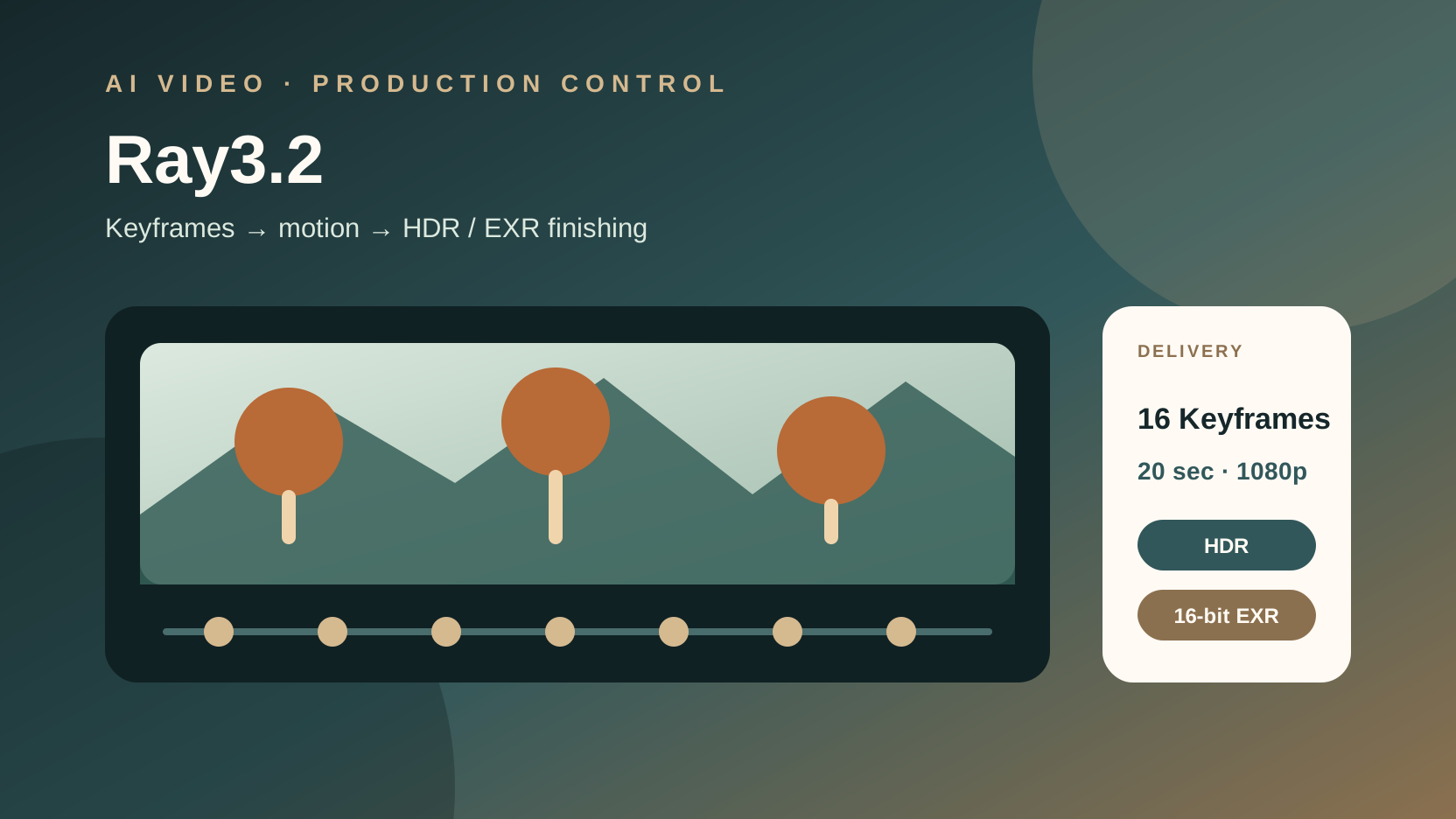
FourFeetz verdict
Ray3.2 is notable because its headline features address shot direction and post-production handoff rather than only visual quality. Up to 16 keyframes, HDR generation and 16-bit EXR export sound production-oriented, but the real test is whether identity, motion and lighting remain coherent between those controls and whether the resulting files survive a normal edit, grade and composite.
Primary source
What this article is based on
Luma · 2026-06-09
Luma Introduces Ray3.2 Model & API: Complete Creative Control for Video Generation
Feature claims below are taken from the official announcement. Production implications and cautions are FourFeetz analysis, not claims made by the vendor.
Read official announcement ↗Confirmed in the announcement
What actually shipped or was announced
- Luma says Multi-Keyframe supports up to 16 keyframes inside a single clip.
- The release supports clips up to 20 seconds at 1080p.
- Ray3.2 includes native HDR generation and 16-bit EXR export for post-production workflows.
- The update includes enhanced performance tracking and expressive facial performance for up to eight faces.
- Ray3.2's control surface is available through an API for integration into custom production tools.
Reality check
What the announcement does not prove
- More keyframes do not automatically produce natural interpolation, stable identity or clean editorial pacing.
- HDR and EXR output formats do not guarantee physically consistent light, useful mattes or artifact-free compositing.
- Vendor claims about performance preservation need testing across occlusion, fast motion, profile views and stylized characters.
- Longer clips can reduce stitching while increasing the amount of footage lost when a late-frame defect appears.
FourFeetz analysis
Sixteen Keyframes Change the Brief
Most image-to-video workflows begin with one approved frame and a text description of what should happen next. Multi-Keyframe changes that input from a starting point into a sequence of visual constraints. A director can define several story beats, camera positions or composition targets inside one clip.
The opportunity is more intentional pacing. The risk is over-constraining the model with conflicting images. Each keyframe must preserve identity, scale, light direction and screen geography. A sequence of individually attractive frames can still be an impossible motion plan.
- Use the fewest keyframes needed to define the shot.
- Check identity and lighting continuity between every adjacent pair.
- Reserve extra keyframes for story beats, not decorative variation.
- Keep a locked frame-number map for review and revision.
FourFeetz analysis
HDR and EXR Matter Only If the Image Holds Up
Native HDR generation and 16-bit EXR export aim at a professional handoff: more tonal range and a file format familiar to compositing and finishing teams. That can be valuable when an AI shot must sit beside live-action plates or survive a controlled grade.
A high-bit-depth container cannot repair unstable texture, invented reflections or inconsistent light. The evaluation should include scopes, channel inspection, highlight recovery, edge behavior and a real composite—not just playback of the default render.
FourFeetz analysis
Performance Preservation Is the Character Test
Luma highlights enhanced performance tracking and expressive facial performance, including tracking for up to eight faces. For character-led work, the smaller question comes first: can one approved character retain body proportion, accessory placement, gaze and emotional timing through a directed shot?
RURU offers a useful stress test because the striped tail, brown collar and gold name tag create clear continuity markers. A successful clip should preserve those protected traits through turns and partial occlusion without freezing the performance.
FourFeetz analysis
Longer Clips and Reframe Shift Where Failures Appear
Twenty-second 1080p clips can cover a complete beat and reduce the number of stitched generations. They also increase exposure to drift. Review should happen at the beginning, every keyframe transition and the final seconds, where geometry and motion errors often accumulate.
Enhanced Reframe can adapt aspect ratio, extend a frame or replace a background while preserving lighting, according to Luma. That is promising for 16:9 and 9:16 delivery, but the vertical version still needs a composition review. Preserved pixels do not guarantee preserved story information.
FourFeetz analysis
The Production Test We Would Run
Build a five-to-eight-second RURU shot with three approved keyframes: reveal from behind a tree, a cautious step and a held reaction. Protect the face, tail pattern, collar, name tag, light direction and screen-right movement. Generate a standard output and an HDR/EXR version.
Score interpolation, identity, accessory continuity, motion cadence, late-frame drift, vertical reframe quality and grading behavior. Then compare the accepted-second cost with the current single-frame workflow. The feature is useful when added control produces a more editable shot, not merely a more complicated setup.
Before adoption
Production checklist
- 1Design a physically possible keyframe sequence with explicit protected traits.
- 2Review every transition rather than checking only the supplied keyframes.
- 3Inspect EXR channels, highlights and edges in the actual finishing software.
- 4Test a vertical reframe for story composition as well as pixel preservation.
- 5Measure accepted seconds, setup time and rejected generations against the current workflow.