FourFeetz Production Experience · Production Record
Protoface + Seedance 2.0 Production Test — What We Learned from a 15-Second Multi-Scene Video
What FourFeetz learned from a roughly 15-second pet-memory sequence in Protoface and Seedance 2.0: one action per scene, emotional boundaries and edited titles.
Production Record
Based on the production experience documented by FourFeetz Studios. Observations from this test are distinct from general claims about model performance.

Quick verdict
For this 15-second test, one main action per scene was easier to manage than a longer prompt. We excluded imagery that conflicted with the emotional purpose and added important wording during final editing.
FourFeetz production notes
Connect several memories in roughly 15 seconds
FourFeetz Studios has recently been using Protoface Studio and Seedance 2.0 as part of our practical AI pet-video production workflow.
For this test, we moved beyond generating a single action and explored how several short memories could be connected within an approximately 15-second sequence.
The pet-memory film begins with a peaceful moment at home, transitions into the dog running happily outdoors, and ends in a warm golden-hour meadow.
One of the most interesting results was how multiple environments could still feel connected when they shared the same emotional direction.
FourFeetz production notes
Give each scene one primary action
However, we also learned that a longer prompt does not automatically produce better control.
What mattered more was simplifying the main action in each scene.
At home: rest comfortably beside a favorite toy.
Outside: run happily through the grass.
In the final meadow: remain peaceful, look toward the camera, and gently wag the tail.
Giving each section one clear primary action made the overall sequence easier to manage.
FourFeetz production notes
Define what would break the emotional direction
Negative direction was also important.
For this memorial project, we explicitly asked the model not to have the dog walk away, disappear, or create imagery associated with death or farewell.
When a film depends on a specific emotional tone, defining what should not happen can be almost as important as describing what should happen.
FourFeetz production notes
Four principles to carry into the next production
Our practical takeaway from this production was simple:
Give each scene one primary action.
Use only the camera movement you actually need.
Describe the pet's behavior clearly.
Explicitly exclude unwanted emotional or visual outcomes.
FourFeetz production notes
Add important typography during final editing
And for important titles or memorial messages, adding typography during final editing can be more reliable than asking the video model to generate the text itself.
Through these experiments, FourFeetz Studios is focusing not only on AI generation quality, but on building a production workflow that can be used for real creative services.
FourFeetz production notes
One scene, one action: a separate hotel concept series
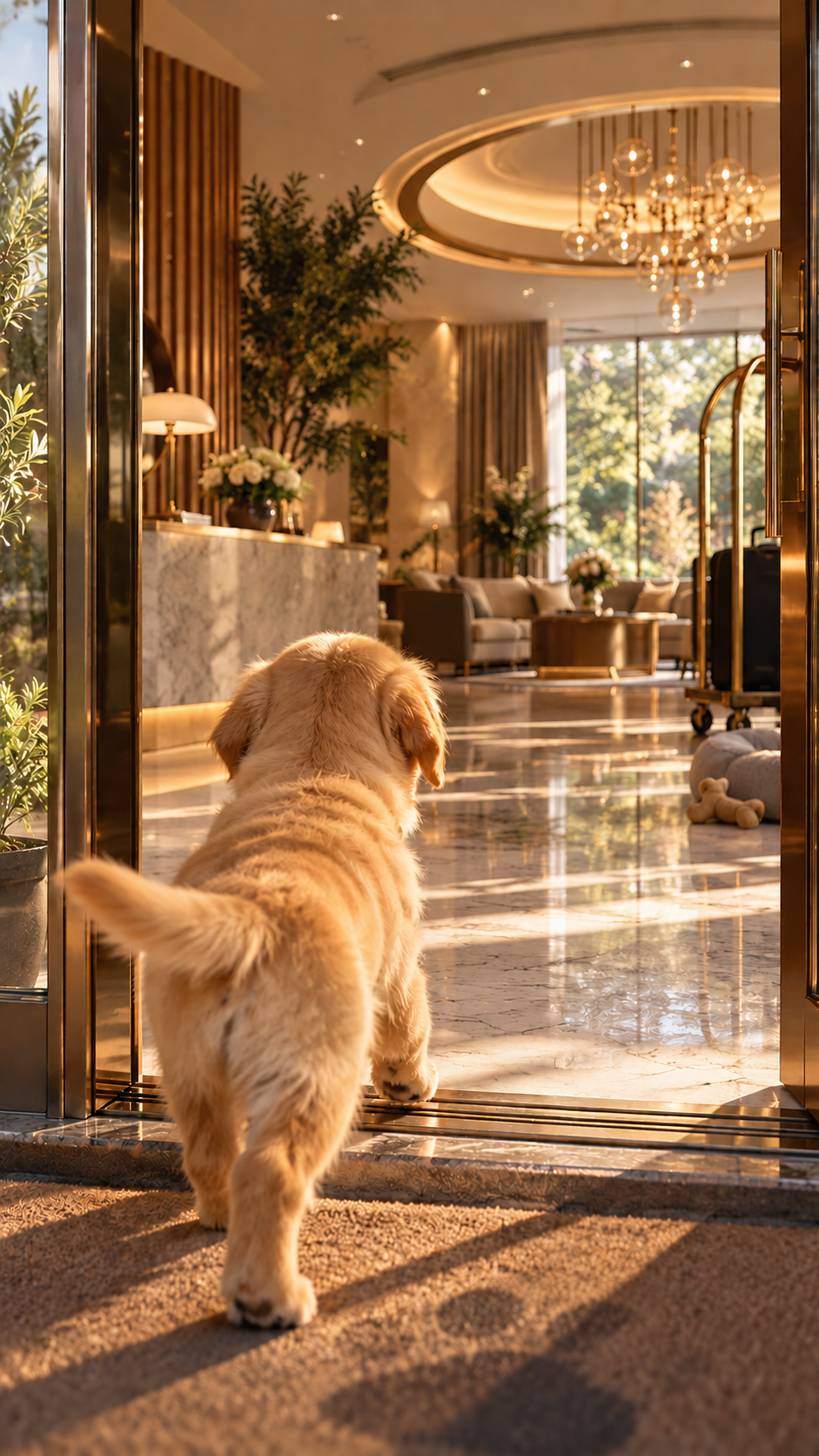
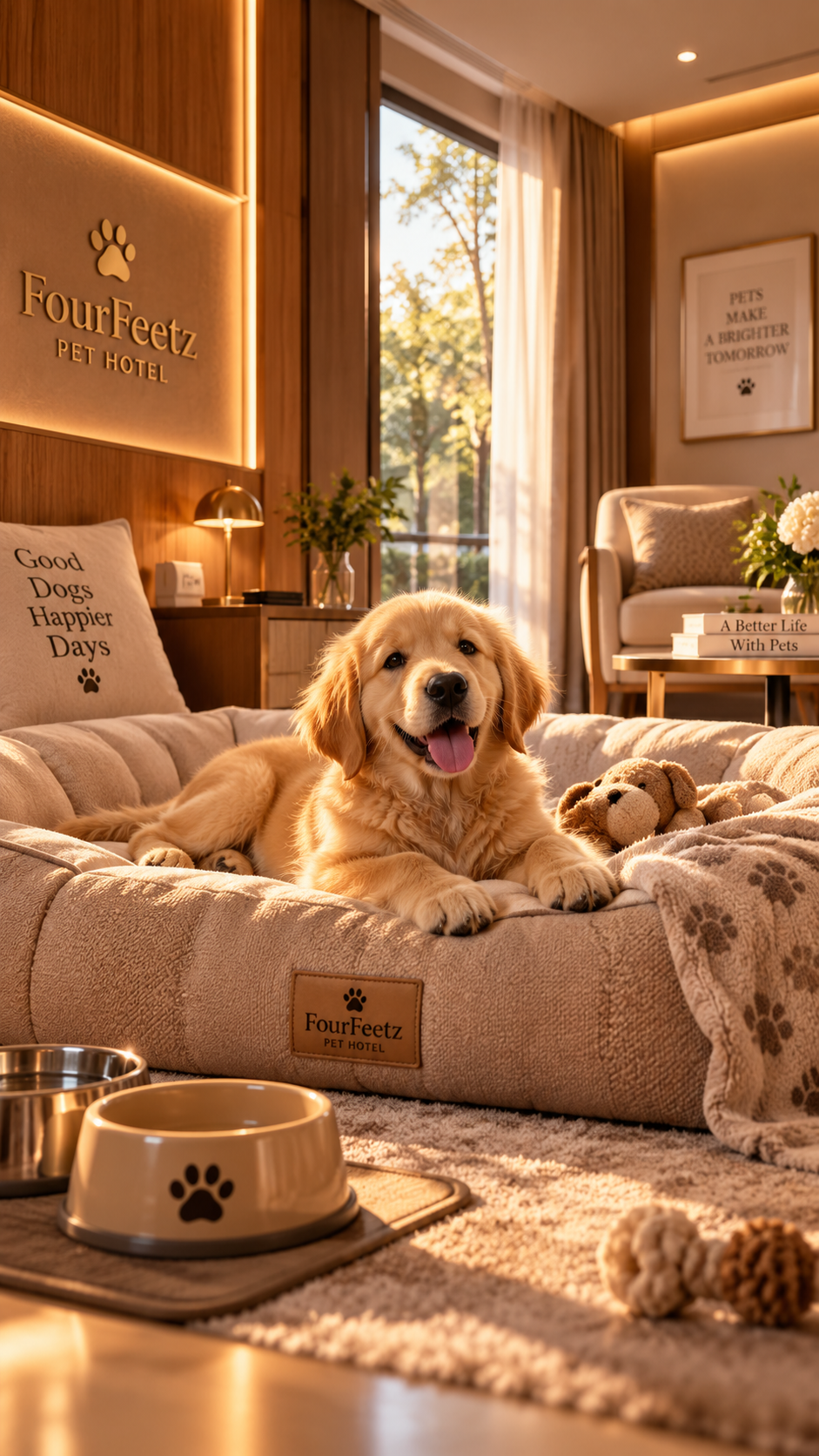
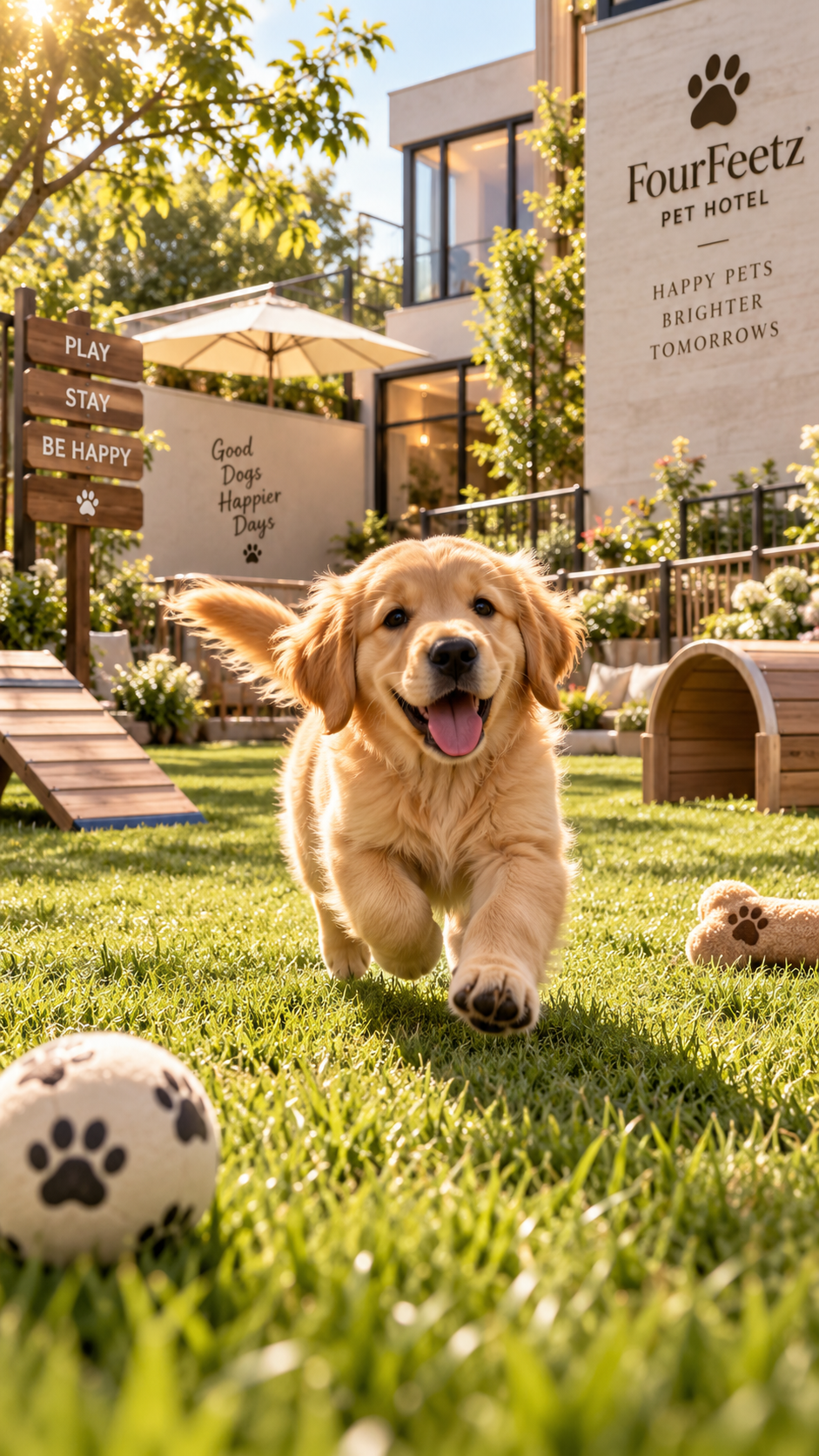
The supplied hotel series presents arrival, resting awake, running on grass, and sleeping as four separate states. These are AI concept images from another project, not extracted frames from the approximately 15-second test discussed above. They provide concrete comparisons for the size of an action assigned to each shot.
In the arrival image, the threshold and lobby establish direction. In the running image, the puppy approaches the camera with paws visible against the grass. The bed and sleeping images depend more on posture and expression. Keeping those different roles avoids adding travel and camera motion to every shot.
The awake and sleeping images both include bedding and a toy, but that does not establish an identical room. Before joining such shots, compare the room layout and prop positions; mismatched images can work as separate memories instead. Logos and lettering visible in the stills also need a readability check in the final edit, since their stability in motion is not established by these images.

FAQ
Questions creators ask us
Is 15 seconds a fixed Seedance 2.0 limit?
Approximately 15 seconds describes this test sequence. It is not a claim about maximum model duration or a specification that applies to every platform or account.
Did a longer prompt produce more accurate control?
In this production, simplifying the action in each scene helped more than adding length. We also added important wording during editing instead of relying on generated text.
Want to turn your pet's memories into a film?
Explore pet video production by FourFeetz Studios.
Start with Protoface Studio